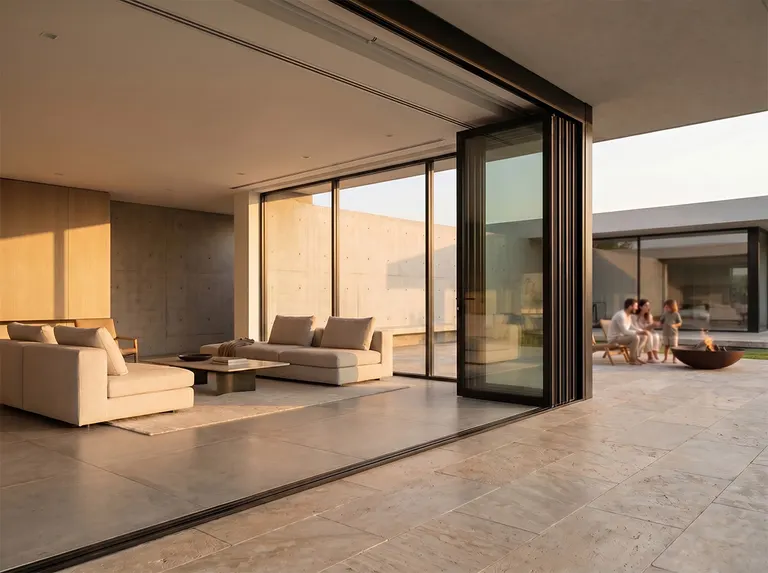
There's a certain feeling that draws people toward large architectural openings.
Not just the glass itself.
Not the mechanics.
Not even the view.
It's the emotional effect of space becoming less confined.
Morning light reaching deeper into the home.
Conversations flowing naturally between the kitchen and patio.
Children moving in and out without barriers feeling so defined.
Fresh air changing the atmosphere of an entire room.
For many homeowners, the appeal of a large opening has less to do with the door — and more to do with how life feels once the boundary between inside and outside becomes softer.
But behind that feeling is an engineering reality most homeowners never see.
And in many cases, the way a large opening is supported structurally changes far more than people realize.
The Hidden Structural Difference Most Homeowners Never Hear About
When homeowners begin researching folding door systems, much of the conversation revolves around visible things:
- frame color
- panel size
- sightlines
- hardware finishes
- glass options
What often receives far less attention is how the weight of the system is actually supported.
That hidden structural philosophy can influence:
- long-term alignment
- operational smoothness
- structural requirements
- retrofit complexity
- future maintenance
- how stable the system feels years later
Most large opening systems fall into one of two categories:
Top-hung systems
Bottom-supported systems
At first glance, they may appear similar.
But structurally, they behave very differently.
What a Top-Hung System Actually Means
In a top-hung system, the majority of the door's weight is suspended from the structural beam above the opening.
That means the header carries much of the operational load.
In smaller openings, this may not create major concerns. But as openings become larger — and panels become heavier — structural movement above the opening becomes increasingly important.
Even small amounts of deflection can affect:
- track alignment
- locking consistency
- panel movement
- long-term smoothness
This doesn't mean top-hung systems are "bad." Many have been used successfully for years.
But it does mean the system becomes highly dependent on what is happening structurally overhead.
The Structural Philosophy Behind Bottom-Supported Systems
A bottom-supported system approaches the problem differently.
Instead of suspending most of the weight from above, the weight transfers downward into the floor structure below.
That changes the structural relationship of the entire opening.
From an engineering perspective, this can help:
- reduce dependency on oversized headers
- improve support consistency
- reduce certain deflection-related issues
- improve long-term alignment stability
- simplify some retrofit conditions
For homeowners, those engineering decisions often translate into something much simpler:
The system tends to feel more stable over time.
Why This Matters More in Real Homes Than Showrooms
Many large door systems feel impressive inside a showroom.
The real test comes later.
Summer heat.
Seasonal movement.
Structural settling.
Years of repeated operation.
Large spans carrying substantial glass weight every single day.
Homes are living structures. Everything moves slightly over time.
The engineering challenge is not creating a system that feels perfect for six months.
The challenge is creating a system that continues feeling refined years later — after temperature swings, structural movement, and daily use begin interacting together.
This is one reason support philosophy matters so much.
Bottom-supported systems are designed around the idea that large openings should remain calm, predictable, and stable under real-world conditions — not only ideal ones.
The Emotional Side of Structural Stability
Most homeowners never say:
"I want better load distribution."
What they actually want is:
- doors that continue gliding smoothly
- panels that remain easy to lock
- operation that still feels refined years later
- fewer surprises
- fewer adjustments
- less stress
This is where engineering quietly becomes emotional.
Good engineering reduces friction in daily life.
The best systems often become almost invisible during ownership. They simply work consistently without demanding attention.
That feeling of ease matters more than many homeowners initially realize.
Why Bottom-Supported Systems Can Simplify Retrofits
Many large-opening projects are not brand-new custom homes.
They're remodels.
An older sliding door is being replaced.
A wall is being opened wider.
A homeowner wants to create more connection between the interior and the outdoors.
In these situations, structural realities quickly become important.
Large top-hung systems may require significant structural considerations overhead because the header becomes such a critical load-bearing component.
Bottom-supported systems can sometimes reduce that dependency.
That does not mean "no engineering required."
Every large opening still deserves proper structural review and thoughtful installation.
But the structural strategy changes — and in many remodel conditions, that can create more flexibility and fewer structural surprises.
For homeowners, that often means a project that feels more understandable and manageable.
Stability Changes the Feeling of the Entire Experience
One of the most overlooked aspects of premium architecture is emotional consistency.
A beautiful system that becomes difficult to operate later creates subtle tension inside the home.
People stop opening it as often. Movement feels heavier. The experience slowly changes.
On the other hand, when a system continues operating smoothly year after year, the architecture remains emotionally effortless.
The opening continues feeling natural. Easy. Integrated into daily life.
That's ultimately what thoughtful support engineering is trying to protect. Not just the structure. The feeling.
The Quiet Goal of Good Engineering
The most successful engineering rarely calls attention to itself.
It quietly supports:
- openness
- reliability
- comfort
- architectural calmness
- confidence in ownership
A homeowner should not need to think constantly about alignment, stress, or adjustment.
The system should simply feel composed.
Stable under sunlight.
Predictable during operation.
Comfortable to live with over time.
That's the deeper reason support philosophy matters.
Because when large openings are engineered thoughtfully, the technology fades into the background — and what remains is the experience people wanted all along:
More light.
More connection.
More openness in everyday life.