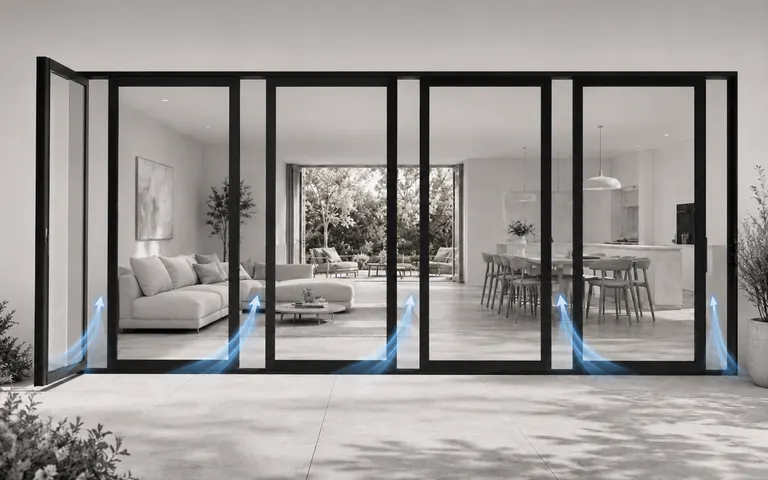
Most people compare folding doors by looking at the finished opening: how wide it gets, how much glass is visible, and how neatly the panels stack. That is only part of the story.
The bigger question is how the door behaves during everyday use. Are the panels tied together as one chain, or can each panel move on its own? That difference shapes traffic flow, ventilation, furniture placement, and how often you actually enjoy the opening.
What a Hinged Bifold Does Well
Traditional bifold doors connect panel to panel with hinges. When you open the system, those panels fold together like an accordion and stack to one or both sides. It is familiar, visually simple, and it can create a wide clear opening.
The tradeoff is that connected panels usually want to move together. A small daily opening can become a bigger gesture than expected, especially on even-panel systems where there may not be a true independent swing door.
Why Independent Panels Feel Different
With independent panels, each panel slides and pivots on its own. You can open one area for daily traffic, spread panels for airflow, gather the opening to one side, or leave a partial wind break in the center.
That flexibility matters because homes rarely use a large opening in only one mode. A Saturday party, a quiet morning, a breezy afternoon, and a quick walk outside all ask different things from the same door.
The best system is the one that lets the opening adapt without making the homeowner think about the mechanics.
The Clearance Question
Hinged bifolds swing out of the track line as they fold. That means furniture, planters, grills, rugs, and balcony depth all become part of the operating path.
Independent panels stay aligned with the track as they slide, then pivot at the stack. For tight patios, shallow decks, and rooms where furniture lives near the glass, that movement path can make the difference between a beautiful feature and a daily compromise.
What to Ask Before You Buy
- Can one panel operate as a daily door without moving the rest?
- Where do the panels swing during opening and stacking?
- How much clear space must remain free inside and outside?
- Can the opening be partially vented without fully stacking the system?
- What happens if only part of the opening is used most days?
A large door should not force one dramatic mode of use. It should give the home more ways to breathe, move, and gather. Movement path is where that difference begins.