The Moment a Perfect Door Stops Working
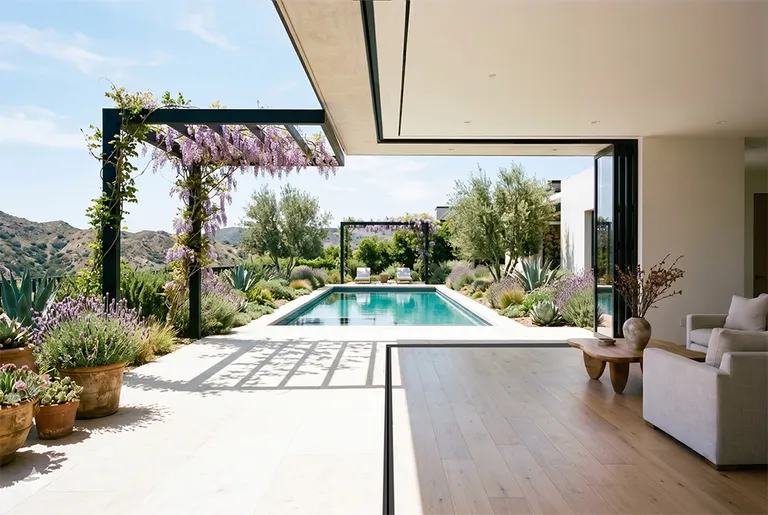
It's a Southern California afternoon. The house is full of people, the weather is perfect, and you go to open your folding door. The panels won't align. The main door won't latch. The stack won't compress. Nothing is broken. Nothing is damaged.
The sun just hit your door.
This is thermal bowing. It affects virtually every thermally broken aluminum folding door on the market, and the industry's own leading manufacturers will tell you the answer is to plant a tree.
When the Sun Becomes a Problem
Aluminum expands when it gets hot. That's physics, not a flaw. The problem starts with the thermal break.
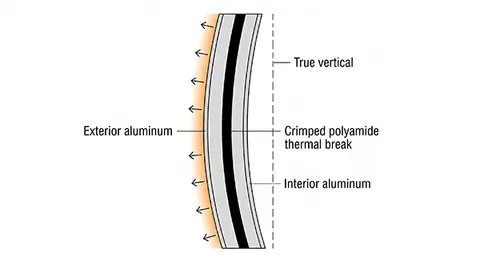
In a standard thermally broken aluminum door, the exterior and interior faces of the frame are two separate aluminum profiles, joined by a strip of polyamide, a rigid plastic thermal barrier that's mechanically crimped in place. That crimp earns the door its energy efficiency ratings. It's also what causes the bowing.
When the sun heats the exterior face of a panel, that face wants to grow longer. The interior face stays cooler and shorter. Both faces are locked together through the crimp, so neither can move freely. The panel bows. Engineers call this the anti-bimetal effect.
On a dark-framed door in Southern California sun, the temperature differential between the exterior and interior face can easily exceed 50°F. Across a vertical stile running anywhere from six and a half to ten feet, that's enough to visibly distort the frame and prevent the door from operating.
Here's What the Competition Suggests
Some manufacturers are at least transparent about it. One of the largest door manufacturers in the country published guidance for customers dealing with thermal expansion. Their recommendations:
- Shelter the door from direct sunlight by adding a porch, awning, canopy, or strategically planted trees
- Choose lighter color finishes, which are "usually least susceptible" to the effect
- "If possible, select non-thermally broken doors to help reduce thermal expansion"
Read that last one again. A major manufacturer's published advice for thermal expansion in their thermally broken doors is to buy a door that isn't thermally broken.
These aren't engineering solutions. They're workarounds, design constraints you're asked to accept and build your home around. If you bought a folding door to live in the light and the outdoors, being told to shade it isn't an answer.
The Problem No One in the Brochure Talks About
In a traditional bifold door, adjacent panels are connected by panel-to-panel hinges. Those hinges act as a mechanical correction system. If one panel bows slightly under sun exposure and the panel beside it doesn't, the hinge physically pulls them together. The problem exists, but the hardware compensates.
FlowDoors uses a slide-and-fold design. Our panels operate independently, without direct panel-to-panel hinge connections. That's what gives you the freedom to open one section, vent another, or configure the opening however you want on any given day. It also means there's no mechanical bridge to compensate when panels disagree.
And panels disagree more often than people expect. Partial shade is one scenario, but so is normal operation. Open two panels for airflow and leave the rest closed, and you've got panels facing completely different directions. The open ones are perpendicular to the sun. The closed ones are taking the full face of it. Some are expanding along their vertical stiles, some aren't. When you go to bring them all together, they're not starting from the same place.
This isn't a rare failure condition. It's what happens on an ordinary afternoon when someone uses their door the way it was designed to be used.
Engineered So the Problem Can't Happen
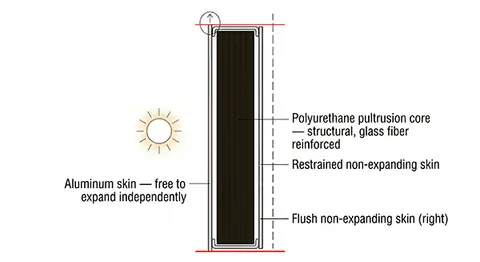
FlowDoors approaches thermal bowing as a system problem, not a cosmetic inconvenience. The panel design is engineered so the warm exterior face and cooler interior face are not forced into the same stressed movement path.
That matters because bowing begins when different parts of a frame want to expand at different rates but are locked together too rigidly. Once that stress has nowhere to go, the panel moves out of plane.
FlowDoors is designed around controlled movement, stable alignment, and hardware engagement that remains predictable when the sun changes the temperature of the exterior face.
No color restrictions as the primary fix. No asking you to build shade around a door you bought for light. The point is a large opening that can live in real sun without turning normal afternoon heat into an operating problem.
A Door That Behaves the Same at 8 a.m. as It Does at 3 p.m.
You don't need to plan your landscaping around your door. Light or dark finish, south-facing wall, two panels open and three closed, it all works the same. The engineering underneath doesn't change when the temperature does.
Southern California is exactly why most people want a folding door. It's also the most thermally demanding environment a door will ever face. FlowDoors was built for both of those facts, not just one of them.
Let's Talk About Your Opening
Every installation is different. Orientation, sun exposure, opening size, finish color, it all factors in. Fifteen years of experience means we've worked through every variable before you have to.