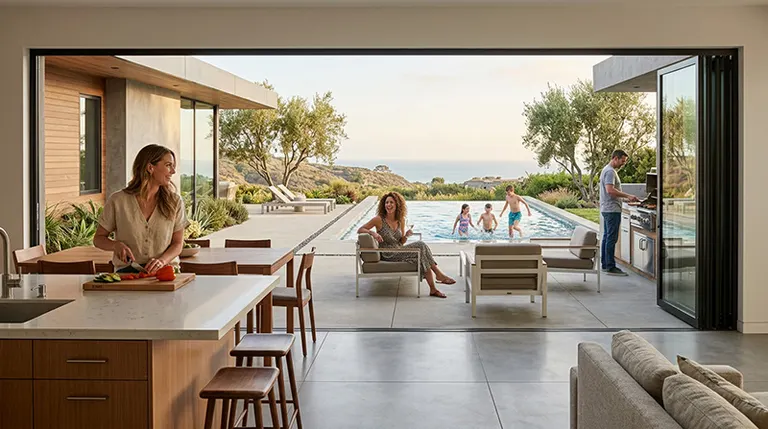
Most homeowners shopping for a wide opening are comparing the same three categories: bifold and accordion doors, traditional sliding doors, and large multi-slide systems.
All three promise a more open home. The difference is what each one asks you to accept in return — in daily use, structure, cost, and how connected the home actually feels.
This guide walks through each system in the same order, so you can see where the trade-offs show up before you compare quotes.
Bifold & accordion doors
Panels Stack Into Your Living Space
Bifold and accordion systems fold as a connected group. They can create a wide opening, but daily life often bends around how they move and stack.
- Hinged panels move as a connected group — not independently along the opening.
- Chairs, tables, toys, and pet beds near the door often have to be moved before it can fully open.
- Panels swing and stack into the room, taking up space you use every day.
- Want fresh air on one side? You may have to open more of the wall than you intended.
- Typically top-hung, which often requires expensive structural headers before the doors can even be installed.
Go deeper on bifold & accordion doors
Traditional sliding doors
Half the Wall Stays Closed
Sliding doors are familiar and simple, but part of the opening usually stays fixed — which limits connection, airflow, and how open the home actually feels.
- Part of the opening stays fixed, so inside and outside can still feel separated.
- Panels only slide back and forth — no center opening or split configuration for airflow.
- At least half the view often stays blocked, even when the system is fully open.
- Heavy panels wear down rollers and tracks over time, affecting glide and seals.
- Harder to create one shared moment — the wall never truly disappears.
Go deeper on traditional sliding doors
Large multi-slide doors
More Structure, More Complexity
Large pocketing and multi-slide systems can open impressively wide, but the project scope and structure behind them are often heavier than homeowners expect.
- Large pocketing layouts add cost, planning, and construction complexity up front.
- May require structural engineering, ceiling support, or finished-wall demolition.
- Heavy hanging weight can stress the header and cause sag, stick, or misalignment over time.
- Pocket space and framing demands may not fit an existing home without a major remodel.
- Less day-to-day flexibility — configuration is often dictated by the track, not how you live.
Go deeper on large multi-slide doors
How FlowDoors Is Designed Differently
FlowDoors was built to avoid these trade-offs. Independent panels slide and swing on their own — without the clearance bifold needs, the fixed glass sliding leaves behind, or the structural complexity of large pocketing systems.
One end panel works as an everyday swing door. The remaining panels move independently, so you can open for entry, vent for fresh air, or disappear the wall when life moves outside.
See why FlowDoors is different